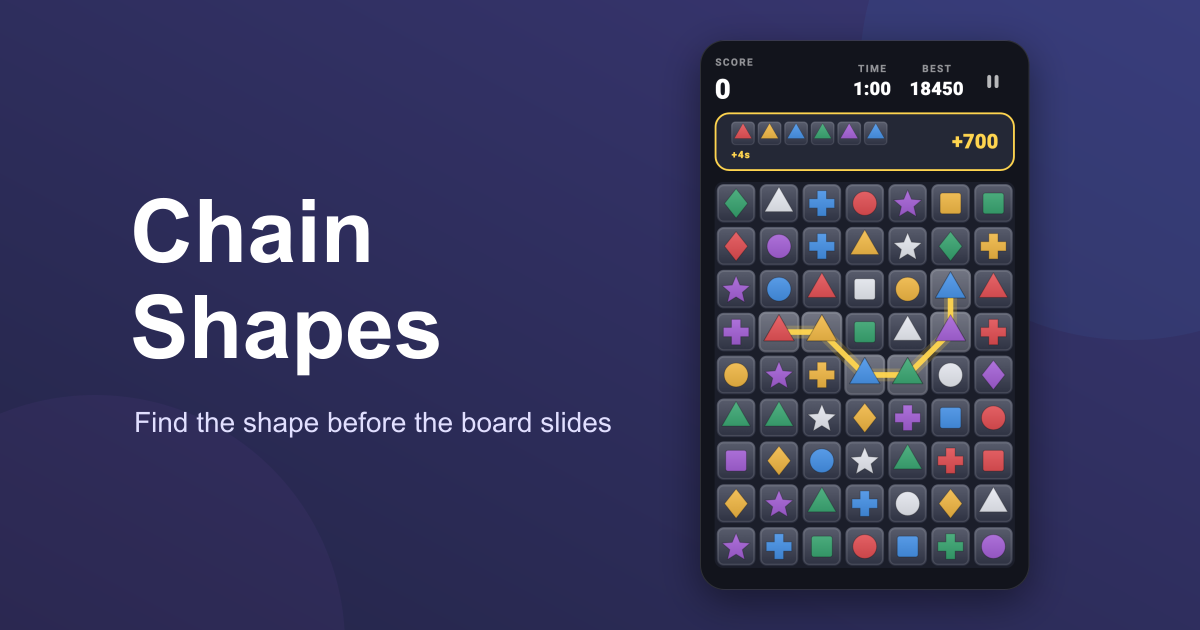
After Chain Letters, I kept playing with the same core loop: touch a tile, drag across its neighbors to build a chain, and lift your finger to score it. This time the tiles show shapes instead of letters, and the board does not stay still while you look at it. The result is Chain Shapes, and you can already play it in your browser, on a computer or a phone. I also plan to publish it on Google Play for Android.
The board moves
The idea that started it is the reel. Every few seconds the board slides one cell: every row on one turn, every column on the next, neighboring lines in opposite directions, with the tile pushed off one edge coming back on the other. A chain you are tracing follows its tiles. If they still touch in order after the slide, you keep going; if the slide pulls them apart, the chain is lost.
Just before a turn, the borders of the tiles that will move blink three times, with a soft tick. Nothing shows which way they will go. You can lift your finger and bank the chain, or keep it and hope the slide brings the tile you need within reach.
What the playtests changed
I played every version on my phone, and most of the rules came from those games rather than from the first plan:
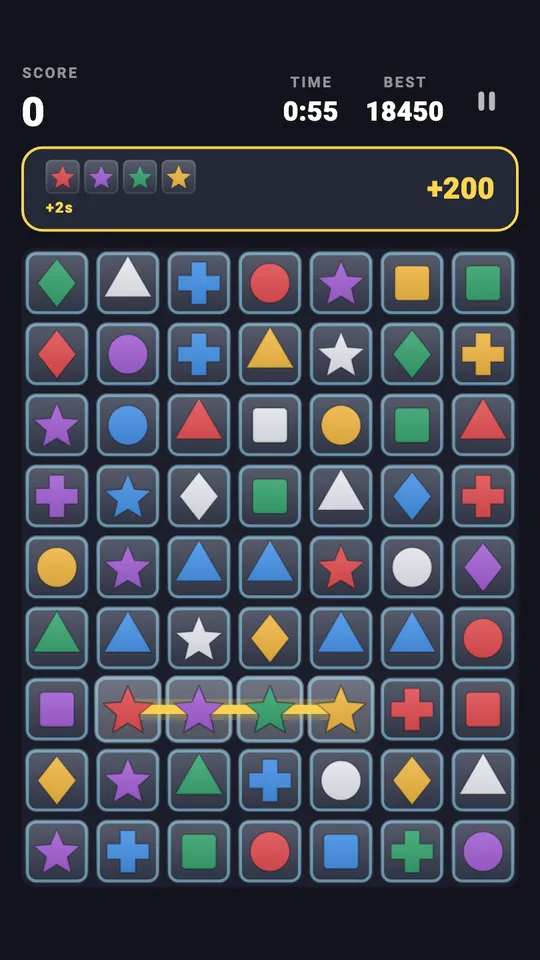
- At first a chain could match one shape or one color, and there were too few of each. Finding a chain was too easy, so the game now has six shapes in six colors, and a chain matches on shape alone. The colors stay as distractors: a red star and a blue star belong to the same chain, but they are harder to see together.
- The reel started as a single row or column every 10 seconds, with an arrow announcing it two seconds before. I wanted the whole board to flow, so it became every row, then rows and columns in turn, every 6 seconds. The arrows became a short blink that tells you a turn is coming, not where the tiles will go.
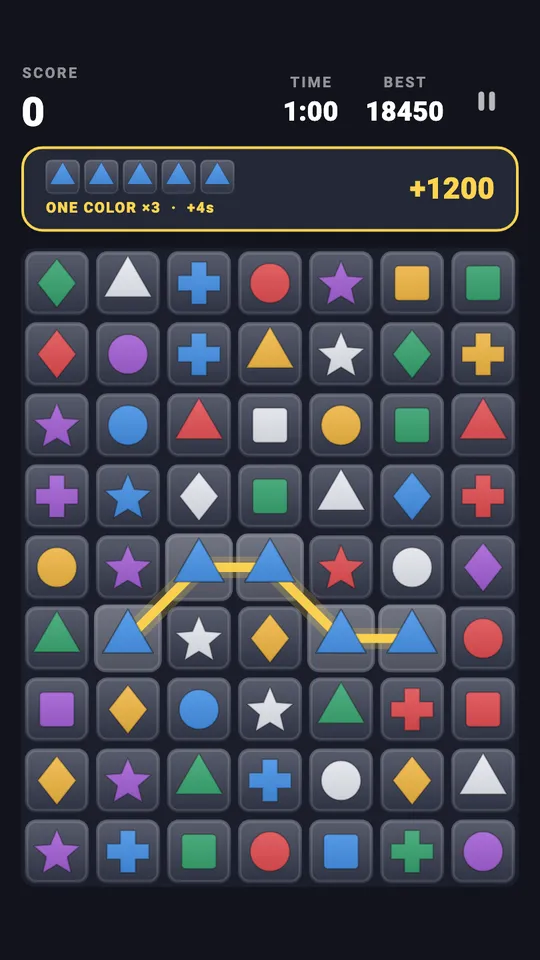
- The bonuses come from Chain Letters: a chain in one color scores double or triple, chains of four or more in a row build a streak, and longer chains earn clock tiles and bombs. The reel added its own: a chain that lives through a slide scores more and earns an anchor, a tile that holds its row and column still.
Tuning the clock
The game speeds up as you score, until the 25th chain: the reel turns from every 6 seconds down to every 3, its blinks get shorter, and each chain adds less time to the clock.
The first game I played with that change lasted 31 minutes and 312 chains before the clock ran out. The game records every chain, and the numbers showed why: past the 25th chain, each one added about as much time as it took me to find it, so the clock barely moved. With less time per chain, the next game lasted 10 and a half minutes.
The game after that lasted 17, because I was getting faster. That record showed something else: most of my chains had three tiles, the shortest that scores, although chains of four or five took me no longer to find. Nothing made the extra tile worth it. Now a longer chain adds more time: once the game stops speeding up, three seconds for three tiles, five for four, and seven for five or more.
Next
Chain Shapes follows the same approach as Chain Letters: a small prototype around one idea, tried and changed until it felt like a game. You can play it in your browser, and read more about it at chainshapes.notonlybits.com.